Be yourself; Everyone else is already taken.
— Oscar Wilde.
This is the first post on my new blog. I’m just getting this new blog going, so stay tuned for more. Subscribe below to get notified when I post new updates.
Be yourself; Everyone else is already taken.
— Oscar Wilde.
This is the first post on my new blog. I’m just getting this new blog going, so stay tuned for more. Subscribe below to get notified when I post new updates.
One hundred years ago, things looked a little different : it took you 5 days to get from London to New York and 3.5 months to travel from London to Australia, in the 1910s, telegram was one of the first methods of communication to connect the world. Nowadays, you can call video to your cousins living in Boston by using Skype and fly from London to Sydney in just about a day! It clearly can be seen that the world has tremendously changed over the last 100 years. In my opinion, globalization, together with the enhancement of technology, has most improved the world. In this essay, I will discuss about the benefits of globalization in three aspects : economy, education and society.
Globalization is a process of global economic, political and cultural integration. It has made the world become a small village, the borders have been broken down between countries. According to most people, globalization started when the Turkish took control of “The Silk Road”, which widened the world and brought goods from other continents into Europe. Other people think that globalization began in the 19th century, along with the development of industrial revolution. Globalization has been playing an increasingly important role in developing countries.
In the field of economy, globalization helps developing countries increase their economy. In the past, developing countries was not able to tap on the world economy due to trade barriers. Nowadays, developed countries are encouraged to invest in the developing nations, creating job opportunities for the poor people. Globalization has made relationships between developed and developing countries stronger, it made each country depend on the other. Furthermore, the growth in the communication between individuals and companies in the world has supporrted free trade between countries, which led to economic growth.
Move to education area, we can see that education has increased in recent years. In 1910s, the world literacy rate was only twenty-three percent. Nowadays, depending on estimates, the world literacy rate is eighty percent. Teaching methods are more widespread thanks to globalization. Developing countries now have more money to provide education for the poor and children living in rural areas. For instance, Vietnam literacy rate has risen from 83% in the 1970s to 93% in 2019. Globalization has facilitated studying abroad in developing contries. Globalized education enhances teamwork and the exchange of ideas among students. Working in multicultural environment allows students to acquire new knowlegde so that they are in good preparation to deal with different circumstances.
In the stage of society, globalization has manny benefits to the health systems and communication in developing countries. According to seniorliving.org , life expectancy in the 1900s was 47 compare with 75 in 2000. Through economic growth, living standards and life expectancy for developing countries are getting better because those countries have more money to supply good health care services for their people. Thanks to important tools of globalization such as television, mobile phone and the internet, people worldwide can know each other better, today we can know what is happening in other countries such as Japan, German,..
In conclusion, as we can see, the process of globalization has involved all the countries around the world. Developing countries such as Vietnam, India, Malaysia, Indonesia, have been affected by globalization, and whether negatively or positively, the economies of these countries have improved under the influence of globalization. I believe that each country should have their own plans to decrease the drawbacks of globalization such as strategies to protect the environment and remain traditional culture.
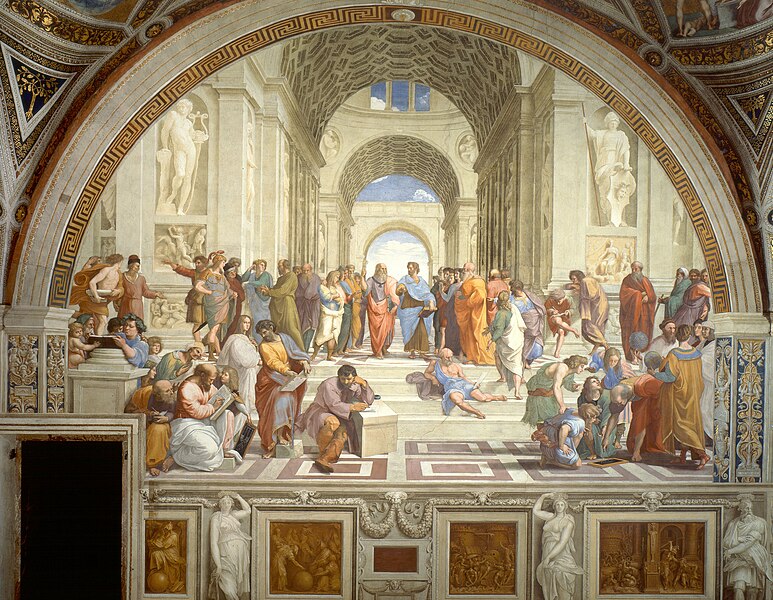
Getting my head buried in renaissance art… the drawing method using perspective grid was extremely attractive lol
The painting above is “The School of Athens” (1509-1511) by Raphael, an Italian artist

My idea process has been like this all the time lol. If you have wondered if there was a particular period of time that you have sorts of new ideas to work the most efficiently, I have the answer for you !
Generally, people who postpone their works until the very near deadline are seemed to have more ideas than the other who don’t. Is this statement true ? Well actually no, it is not completely true. Organizational psychologist Adam Grant took a experiment to figure this out. People participated in are asked to generate new business ideas and then independent readers will evaluate how useful and creative they are. They are separated into two groups : some are asked to do the task right away, some are assigned to procrastinate with Minesweeper dangling in front of them for either five or ten minutes. The result was surprising : the people with Minesweeper in front of them for five minutes are 16% higher than the other two groups. “But Minesweeper is not the driver of the effects, if you played the game before the task, there will be no creativity boost” he said, “It’s only when you are told that you are going to deal with a problem and then you start procrastinating, but the task is still active in the back of your mind that you start to have more ideas. Procrastination gives you time to consider divergent ideas, to think in nonlinear way and to make unexpected leaps”.
According to the Ted talk of Organizational psychologist Adam Grant “The surprising habits of original thinkers” https://www.ted.com/talks/adam_grant_the_surprising_habits_of_original_thinkers?utm_campaign=tedspread&utm_medium=referral&utm_source=tedcomshare
10 p.m staying in my room listening to jazzhop and tadda ~ I decided to start this blog all of a sudden xD . This will be the place where I can share things randomly jumped out of my head xD .You can see a blue space photo on the top of this blog, hope this wanderer can take you to the space of thoughts xD. My writing isn’t very good so it will take a while to get used to writing blogs, but I believe that the more I write, the more I can improve it. Now take a seat and we’ll start our adventures ! Feeling so good right now xD.
This is an example post, originally published as part of Blogging University. Enroll in one of our ten programs, and start your blog right.
You’re going to publish a post today. Don’t worry about how your blog looks. Don’t worry if you haven’t given it a name yet, or you’re feeling overwhelmed. Just click the “New Post” button, and tell us why you’re here.
Why do this?
The post can be short or long, a personal intro to your life or a bloggy mission statement, a manifesto for the future or a simple outline of your the types of things you hope to publish.
To help you get started, here are a few questions:
You’re not locked into any of this; one of the wonderful things about blogs is how they constantly evolve as we learn, grow, and interact with one another — but it’s good to know where and why you started, and articulating your goals may just give you a few other post ideas.
Can’t think how to get started? Just write the first thing that pops into your head. Anne Lamott, author of a book on writing we love, says that you need to give yourself permission to write a “crappy first draft”. Anne makes a great point — just start writing, and worry about editing it later.
When you’re ready to publish, give your post three to five tags that describe your blog’s focus — writing, photography, fiction, parenting, food, cars, movies, sports, whatever. These tags will help others who care about your topics find you in the Reader. Make sure one of the tags is “zerotohero,” so other new bloggers can find you, too.

 Teddi's Blog